How to Read a Contact Lens Prescription

Care & Safety Aug 3, 2026 7 min read

Reading a contact lens prescription is easier than it looks — SPH is your lens power, BC is the base curve (how curved the lens is), DIA is the diameter (how wide it is), and OD/OS simply tell you which eye each line belongs to. In this guide, we break down every abbreviation you’ll see, walk through a real prescription line by line, and show you exactly what to enter when you order colored contacts from us.

In this guide:

  • What OD, OS, and OU mean (right eye, left eye, both)
  • SPH, BC, and DIA — and what each number tells you
  • CYL, axis, and add — only if your prescription includes them
  • Expiration dates, and what to enter at our checkout

What Is a Contact Lens Prescription?

A contact lens prescription is written by an eye care professional after a contact lens exam. It lists the exact lens specifications that fit your eye and correct your vision — and for cosmetic lenses, it confirms that a lens with your eye’s measurements is safe for you to wear. That is why U.S. regulations require a valid prescription for all contact lenses, including zero-power cosmetic lenses.

A contact lens prescription is not the same as a glasses prescription: it includes the base curve and diameter of the lens itself, which only a contact lens fitting can measure. If you’re new to the whole process, our prescription colored contacts guide explains how to get one and what it costs.

OD vs. OS: Which Eye Is Which

Prescriptions always tell you which eye each set of numbers belongs to:

  • OD (oculus dexter) = your right eye
  • OS (oculus sinister) = your left eye
  • OU (oculus uterque) = both eyes

Your right and left eye often have different numbers — that is completely normal. When you order, just make sure the numbers for each eye go into the matching box so we send the right lens for the right eye.

SPH (Sphere): The Power Number

SPH is the strength of the lens, measured in diopters. The rule of thumb:

  • Minus (−) corrects nearsightedness (you struggle with distance). Example: −2.50
  • Plus (+) corrects farsightedness (you struggle with close-up). Example: +1.25
  • 0.00 (plano) means no vision correction — the lens is purely cosmetic

Powers typically step in 0.25 increments, so you’ll see numbers like −1.50, −2.75, or +0.75. If your prescription says PL or “plano,” you have zero power — exactly what you’d choose if you only want the color.

BC (Base Curve) and DIA (Diameter): The Fit Numbers

These two numbers make contact lens prescriptions different from glasses prescriptions:

  • BC (base curve) — the curvature of the inside of the lens, measured in millimeters. It should match the curve of your cornea so the lens sits comfortably. Typical values are 8.4–8.8 mm.
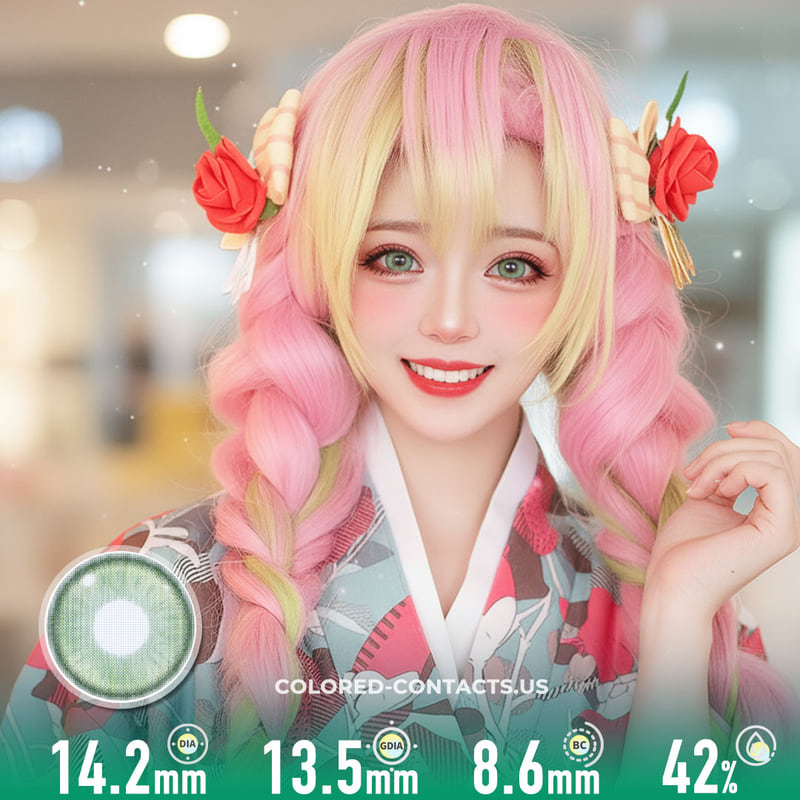
  • DIA (diameter) — the width of the lens, also in millimeters. Most lenses are 14.0–14.5 mm; larger diameters cover more of the iris and create a more dramatic color effect.

If you’re choosing colored contacts, DIA matters more than you’d think — a 14.2 mm lens gives a bold color change, while a 14.0 mm lens looks more natural. Our guide to choosing colored contacts by size, comfort, and BC covers the details.

CYL, Axis, and Add: Only If You Have Astigmatism (or Presbyopia)

Not every prescription includes these — only about 1 in 3 do:

  • CYL (cylinder) — the extra power needed for astigmatism, written as a minus number like −0.75
  • Axis — the angle (in degrees, 1–180) that the cylindrical correction is aligned to, like 180°
  • Add — an additional power for near vision, usually only on multifocal prescriptions

If your prescription lists CYL and axis, you need a toric lens, and most colored contacts come in toric options. Read our guide to wearing colored contacts with astigmatism before you order so you pick the right type.

Check the Expiration Date — Every Time

Contact lens prescriptions expire, usually after one to two years depending on your state. An expired prescription cannot be used to order lenses, so check the date before you shop. And if your vision has changed, book a new exam — a lens with the wrong power is not worth the risk. Wearing a lens that doesn’t fit well can scratch your eye or block oxygen, which is why our colored contacts safety guide is worth a read before your first pair. When in doubt, a quick call to your optometrist’s office will confirm whether your prescription is still current.

A Real Prescription, Read Line by Line

Here’s what a typical prescription looks like and how to read it:

EyeSPHBCDIAExpires
OD (right)−2.508.614.22027-06-30
OS (left)−1.758.614.22027-06-30

In this example, the right eye needs a −2.50 lens and the left eye needs −1.75. Both eyes use the same 8.6 mm base curve and 14.2 mm diameter, and the prescription is valid until June 2027. That’s everything we need to fill an order — plus the brand and material specs from the same document, if your doctor listed them.

What to Enter When You Order from Us

Our checkout is built so you never have to decode anything alone:

  • Choose your power. Select 0.00 if you want plano (cosmetic-only), or enter your SPH power such as −2.50.
  • Enter your BC and DIA if your prescription lists them — otherwise we use the standard fit for your chosen lens.
  • Place your order, then verify. We confirm your prescription through our prescription verification page before any order ships.

No valid prescription, no shipment — that’s a rule we take seriously, and it keeps every pair safe for your eyes. If you’re unsure about any number on your prescription, our customer service team will walk you through it after you order.

Shop Colored Contacts with Your Prescription

Ready to put that prescription to use? These everyday styles are all available with prescription power or as 0.00 plano:

Browse our complete prescription colored contacts guide to compare more colors, sizes, and styles — and remember, the prescription you already have is all you need to get started.

FAQ

Frequently Asked Questions

What does OD and OS mean on a contact lens prescription?

OD stands for oculus dexter and means your right eye; OS stands for oculus sinister and means your left eye. OU means both eyes. Your two eyes often have different powers, so always match each eye’s numbers to the correct box when ordering.

Is a contact lens prescription the same as a glasses prescription?

No. A glasses prescription only lists lens power, while a contact lens prescription also includes the base curve (BC) and diameter (DIA) of the lens, which are measured during a contact lens fitting. You cannot order contacts using a glasses prescription alone.

What does BC mean on a contact lens prescription?

BC stands for base curve — the curvature of the inside of the lens, measured in millimeters. It should match your cornea’s curve so the lens fits comfortably. Typical values are 8.4–8.8 mm, with 8.6 being the most common.

What does DIA mean on a contact lens prescription?

DIA stands for diameter — the width of the lens in millimeters. Most lenses measure 14.0–14.5 mm. A larger diameter covers more of the iris, which gives colored contacts a bolder, more visible color change.

How long is a contact lens prescription valid?

Most contact lens prescriptions expire after one to two years, depending on your state. Always check the expiration date before ordering — an expired prescription cannot be used, and you’ll need a quick new exam to renew it.

Can I order colored contacts with my glasses prescription?

No — U.S. regulations require a valid prescription for all contact lenses, including zero-power cosmetic lenses, and a contact lens prescription is different from a glasses prescription. Book a contact lens exam so your doctor can fit the lens and write the right prescription.